Fujikura 22S vs 41S vs 90S. Which Fusion Splicer Is Right for You?
Fujikura 22S vs 41S vs 90S, Which Fusion Splicer Is Right for You?
Fujikura makes some of the most widely used fusion splicers in the world, and their range covers everything from lightweight FTTH units to high-precision core alignment machines built for backbone network work. If you're trying to decide between the 22S, 41S and 90S, the good news is that they're all excellent machines. The question is which one suits your specific application and budget.
If you're weighing up the cost difference between new and refurbished models, our article on new vs refurbished Fujikura fusion splicers covers the key considerations.
Here's a straightforward breakdown.
The key difference: alignment type
Before comparing individual models, it helps to understand the fundamental difference between cladding alignment and core alignment, since this is what separates the 22S and 41S from the 90S.
Cladding alignment splicers align fibres by their outer cladding. This works well for the vast majority of everyday splicing tasks, particularly on modern fibres where the core is precisely centred within the cladding. Core alignment splicers go a step further and actively align the fibre cores themselves using camera images, which results in lower average splice loss and is particularly valuable when working with older legacy fibre, where the core position can vary.
For most FTTH and access network installation work, cladding alignment is perfectly adequate. For backbone, long-haul and precision-critical work, core alignment is the better choice.
Fujikura 22S
The 22S is a compact, lightweight active cladding alignment splicer designed specifically for FTTH and access network applications. It uses moveable V-grooves rather than fixed ones, which significantly reduces the risk of errors caused by dust and contamination — a real-world advantage when you're working in the field rather than a clean lab environment.
Despite its small size it's a fully ruggedised unit with shock, dust and moisture protection, a 4.7 inch monitor that's readable in bright sunlight, and a battery rated for up to 200 splice cycles. Splice time is around 9 to 11 seconds depending on settings.
It's a solid, no-nonsense workhorse for contractors and engineers doing volume FTTH installs where portability matters and the work doesn't require the precision of core alignment.
Fujikura 41S
The 41S sits a step above the 22S. It's also a cladding alignment splicer but uses a dual-camera active V-groove system and incorporates Warm Splice Imaging technology, which evaluates core alignment during the heating process rather than relying solely on the cladding. In practical terms this means more accurate splice loss estimation and more consistent results, particularly on variable fibre.
Splice time on the 41S is around 6 seconds, which is noticeably faster than the 22S. Battery life is rated for up to 200 splice cycles, and electrode life extends to 5,000 splices, reducing maintenance downtime. The 41S also supports Bluetooth connectivity with the CT50 cleaver for automated blade management.
The 41S is the natural choice for engineers who need something more capable than the 22S but don't require full core alignment. It works well across FTTH, FTTx, LAN and access network applications, and its speed makes it well suited to higher volume field work.
Fujikura 90S
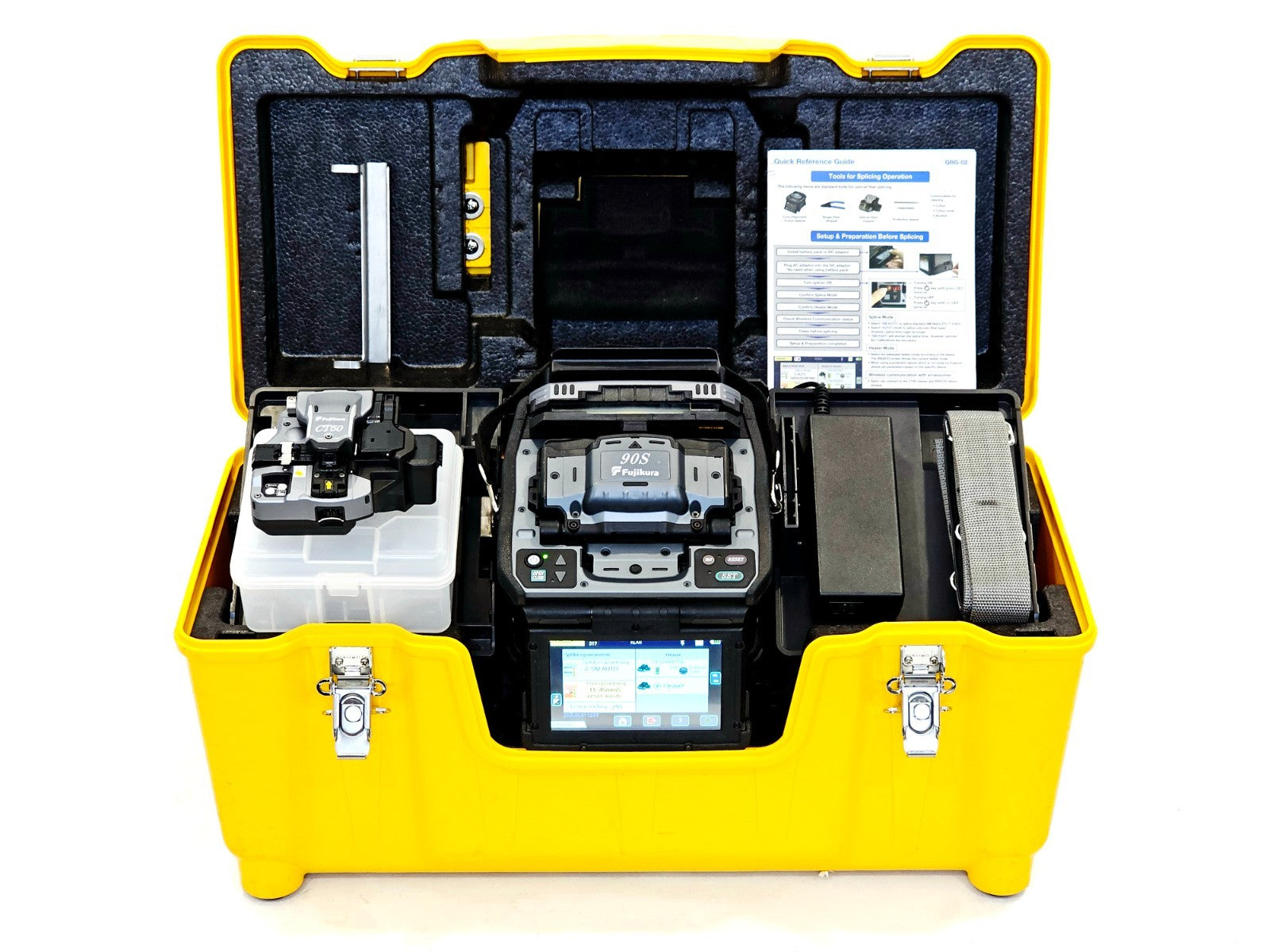
The 90S is a core alignment machine and Fujikura's flagship single-fibre splicer for field use. It uses active core alignment technology with advanced image processing, meaning it directly aligns the fibre cores for the most precise and lowest-loss splices achievable. Typical splice loss on the 90S is around 0.02dB on singlemode, compared to 0.03dB or higher on cladding alignment units.
It's built for demanding applications including long-haul terrestrial networks, backbone infrastructure, splice-on connector work, and situations where you're regularly splicing into older legacy fibre. The automated wind protector, sheath clamps and fibre retention clamps allow the entire splice process to run without the operator touching the machine once fibres are loaded. Battery life is rated for up to 300 splice cycles.
The 90S+ is the updated version of the 90S, adding Active Fusion Control technology which analyses cleave end-face quality and automatically adjusts arc parameters to compensate, and Active Blade Management which communicates wirelessly with the CT50 cleaver to track and rotate the blade automatically.
For more on what proper servicing involves and why it matters, see our guide to Fujikura fusion splicer servicing.
Which one should you buy?
If you're doing primarily FTTH and access network installation and need a compact, portable unit at an accessible price point, the 22S does the job reliably. If you want faster splice times, better loss estimation and Bluetooth cleaver management without moving to full core alignment, the 41S is the upgrade worth making. If you're working on backbone, long-haul or precision-critical applications, or regularly splicing legacy fibre, the 90S or 90S+ is the right tool.
As a rough guide: the 22S suits installers, the 41S suits field engineers, and the 90S suits network contractors and telecoms engineers working on infrastructure projects.
All three are available refurbished from TT Instruments, professionally tested and dispatched from our UK warehouse. Browse our current Fujikura fusion splicer range to see what's in stock.