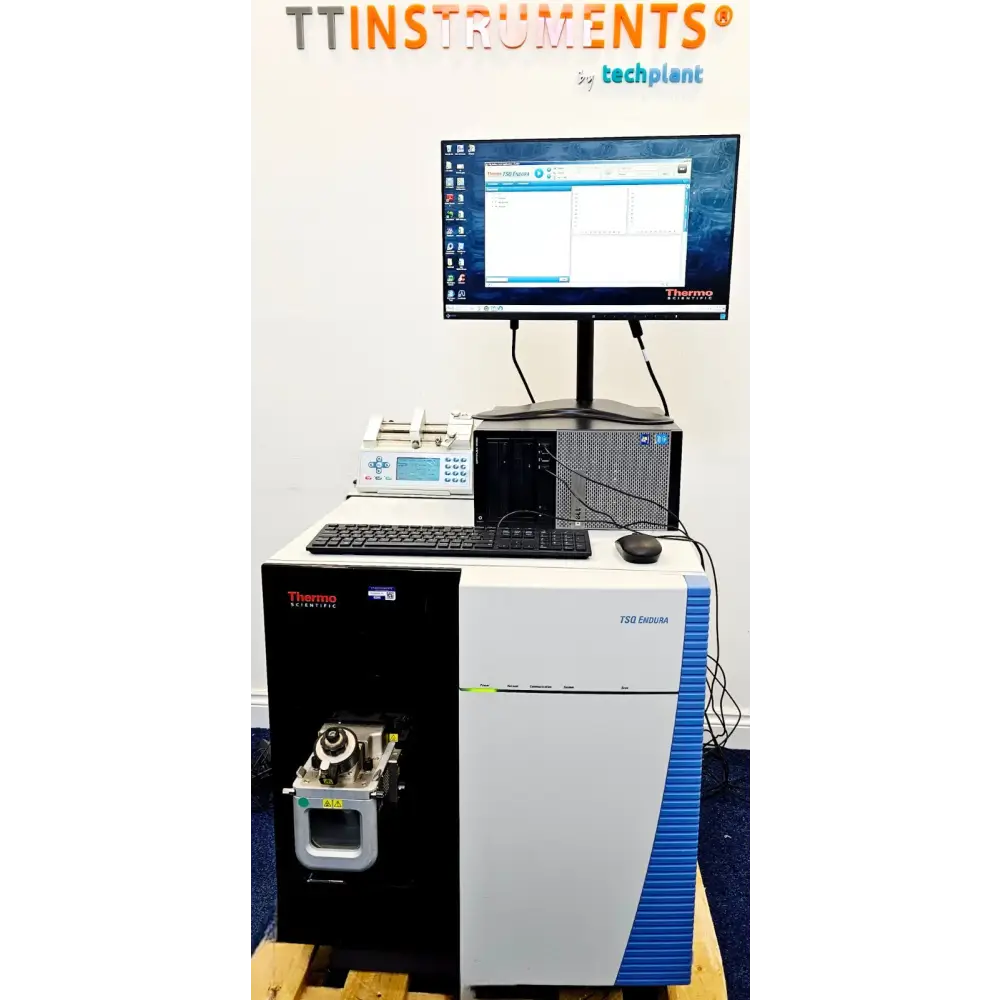
The Thermo Scientific TSQ Endura triple-stage quadrupole mass spectrometer delivers extreme quantitative performance with best-in-class sensitivity, exceptional robustness, and simplified operation for high-throughput laboratories. Designed to provide consistently low limits of detection and quantification even for complex matrices, the TSQ Endura integrates advanced ion optics, high-efficiency collision cell technology, and intuitive software to maximize productivity and data quality.
At the heart of the system is the EASY-Max NG API source with automatic gas and voltage connections, interchangeable HESI and APCI probes, optimized spray geometry, and sweep gas technology to minimize chemical noise and improve uptime. Ions are efficiently focused using the RF-Lens stacked-ring ion guide and filtered through hyperbolic quadrupole mass filters for superior sensitivity and selectivity. The active argon collision cell enables ultrafast selected-reaction monitoring of up to 500 SRMs per second with zero cross-talk, while the dual-mode discrete-dynode detector provides six orders of dynamic range for high-confidence quantitation.
The TSQ Endura is tightly integrated with Thermo Scientific Xcalibur software for instrument control, tuning, diagnostics, and method development. Advanced scan modes include full scan, SIM, SRM, product ion scanning, precursor ion scanning, neutral loss scanning, polarity switching, and quantitation-enhanced data-dependent MS/MS. Optional application-specific software packages support regulated environments, food safety, environmental analysis, clinical research, forensic toxicology, and advanced compound identification workflows.
Performance highlights include a mass range of m/z 10 to 3400, adjustable quadrupole resolution down to 0.4 Da FWHM across the full range, ultrafast scan rates up to 15,000 amu per second, and exceptional sensitivity in both positive and negative ionization modes. The system maintains outstanding mass stability over extended operation, ensuring reproducible quantitative results day after day.
Built for reliability in demanding laboratory environments, the TSQ Endura features a four-stage differentially pumped vacuum system with integrated turbomolecular pumping, automated divert valve and syringe pump for solvent management, and compact footprint for efficient lab integration. It is engineered to deliver high performance without the complexity traditionally associated with triple quadrupole mass spectrometry, allowing users to focus on results rather than instrument maintenance.
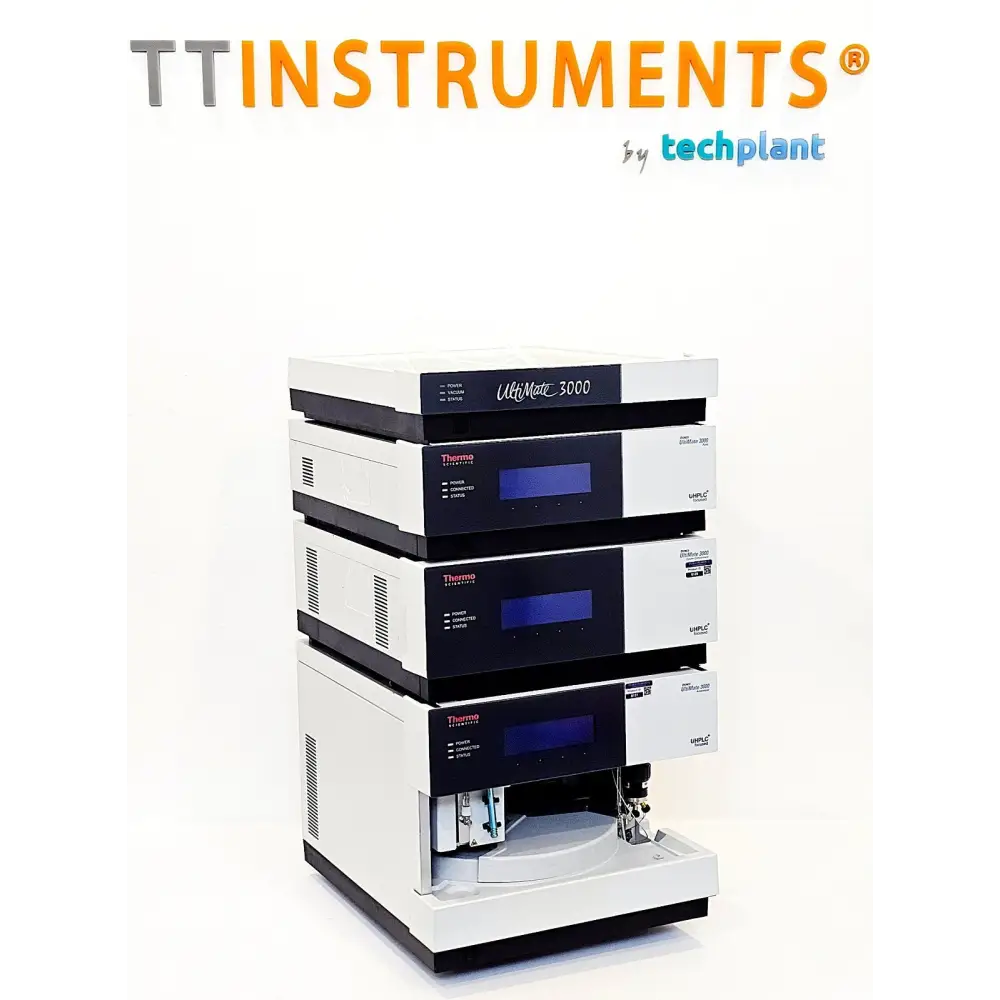
Ensure the consistency of your retention times with accurate and precise temperature control of standard flow rate applications. The Thermo Scientific™ Dionex™ UltiMate™ TCC-3000SD Standard Thermostatted Column Compartments support methods at temperatures from 5° to 80°C. Optional column switching valves (field upgrade) allow application switching or parallel and tandem two-dimensional liquid chromatography (2D-LC) to improve separations and increase productivity with x2 dual technology. The UltiMate TCC-3000SD is recommended for use with all Thermo Scientific™ Dionex™ UltiMate™ 3000 Standard (SD) LC systems.
Features of TCC-3000SD:
- Temperature range of 5° to 80°C ±0.5°C and stability of ±0.1°C simplifies method optimization.
- Precise temperature control under varying ambient conditions ensures retention time precision.
- Fast heat-up/cool-down times minimize delays when changing between methods.
- Eluent preheaters deliver sharper peaks and better resolution.
Pump:
Increase your binary method flexibility. The Thermo Scientific Dionex UltiMate HPG-3400SD Standard Binary Pump allows four different mobile phases, two at a time. Thermo Scientific SmartFlow technology delivers pulse-free flows without a damper to ensure precise retention times. With support for pressures up to 62 MPa (9,000 psi/620 bar) at flow rates up to 10 mL/min, UltiMate 3000 SD pumps excel in standard LC applications and offer full compatibility with fast UHPLC separations, including short sub-2 µm particle columns for faster analysis and lower solvent consumption.
This pump is recommended for use within the UltiMate 3000 Binary Standard system. The HPG-3400SD pump is ideal for routine analyses with an added measure of flexibility using conventional LC and high-throughput LC in the pharmaceutical, food and beverage, and environmental industries. UltiMate 3000 Standard SD and Rapid Separation (RS) pumps and system configurations provide similar gradient delay and extra-column volumes. This simplifies method transfer between method development labs commonly using UHPLC pumps and QC and production labs with their standard LC pump setups.
Features of HPG-3400SD:
- Serial dual-piston operating principle, high-pressure gradient proportioning.
- Wide operating flow rate range from 100 µL to 10 mL/min with high flow rate accuracy.
- Support of operating pressures up to 62 MPa (9,000 psi/620 bar).
- Thermo Scientific SmartFlow technology to automatically compensate for compressibility; no manual solvent setting needed.
- Large selection of mixing volumes to perfectly balance gradient delay volume with mixing efficiency.
- Active rear-seal wash and floating pistons to maximize seal lifetime and pump uptime.
Autosampler:
Enjoy wide application flexibility in a cost-effective, dependable autosampler. The Thermo Scientific™ Dionex™ UltiMate™ Standard Well Plate Autosampler is highly versatile in sample format and injection volume. It can rapidly, accurately, and precisely inject from 1 to 100 μL for conventional LC and up to 62 MPa (9,000 psi) for UHPLC applications. The in-line split-loop (flow-through) injection design puts the needle and sample loop directly in the high-pressure fluid path. Combined with an external needle wash option, carryover is essentially eliminated.
Flexible Formats for Low-Flow Applications:
- The sample rack handles up to three well plates (96 or 384 wells—sealed or unsealed) or sample vial trays in any combination.
- Run your samples in the same format used for preparation, and sample plates can be exchanged during a run.
- An optional cooler preserves thermolabile samples by chilling to 4°C.
- The UltiMate 3000 RSLCnano Well Plate Autosampler (WPS-3000TPLRS) is ideal for highest injection precision at nano, capillary, and micro flow rates in UHPLC applications.
Maximize Throughput:
- Three-well plate capacity holds up to 1152 samples.
- Large injection range from 10 nL to 125 μL offers application flexibility.
- Stable injection valve pressure extends up to 90 MPa.
- Thermostatted sample compartment keeps temperature constant from 4 to 45°C or 22°C below ambient.
Ensure Accurate Small Sample Performance:
- Covered and thermostatted sample tray protects thermo- and UV-labile samples.
- Dual-needle injection principle minimizes sample loss.
- Injection precision <0.25% RSD at 5 μL (typically <0.15% RSD).
- Low carryover (typically <0.01%).
Injection Mechanism:
Using the dual-needle principle, the vial septum of the well seal is pierced by the stainless steel outer needle. The sampler guides the fused silica capillary sampling needle through the piercing needle down to the bottom of the sample carrier. Sample needle height is easily programmed to match sample vial or well depth. Injections of minute sample volumes with virtually zero sample loss—1 μL injection per 1 μL sample—are performed using the μL-pickup routine. This routine is particularly important when injecting protein samples that cannot be diluted without the risk of protein loss or alteration.